Is fashion out of touch?
Clarisse Robilliart
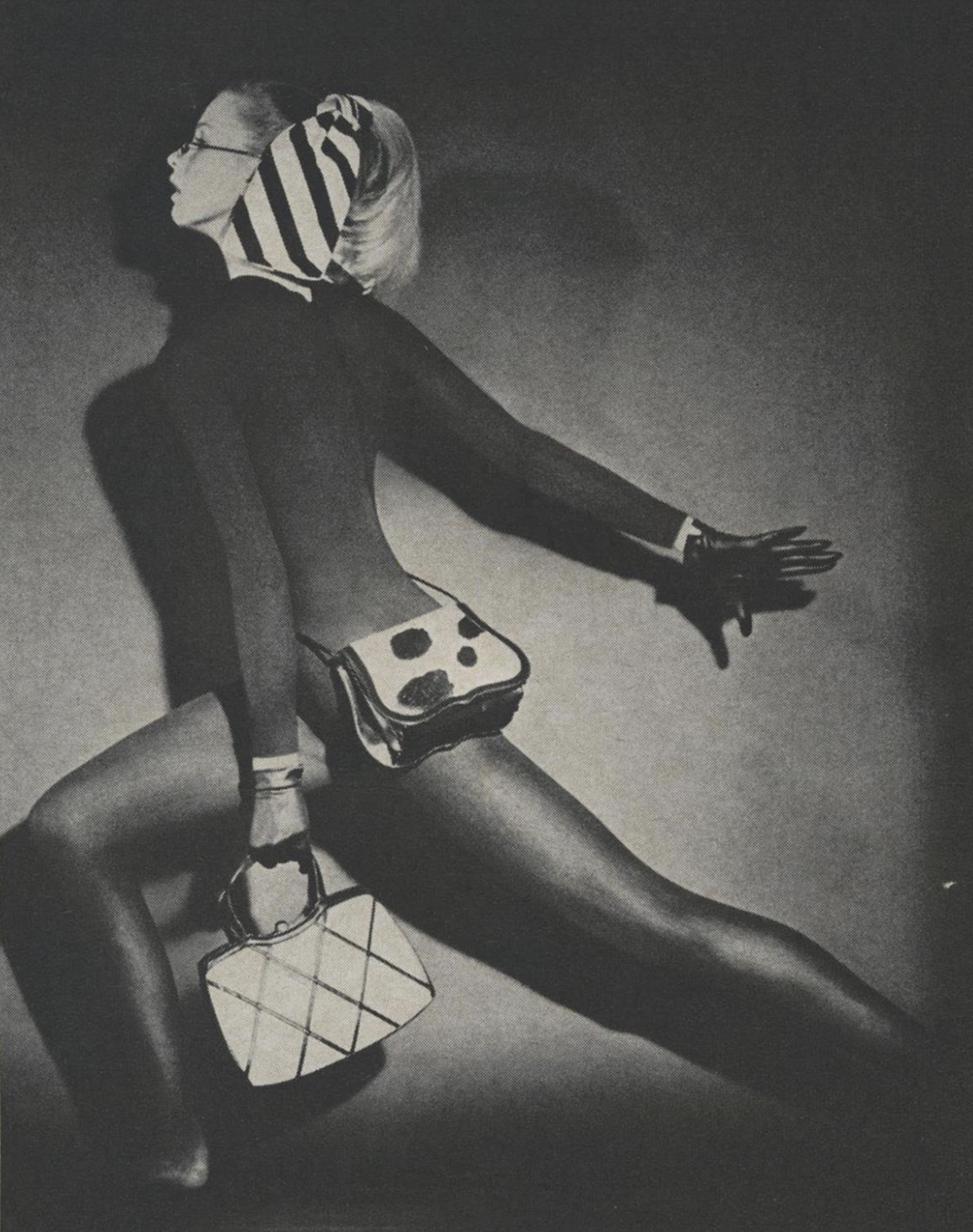
Is fashion out of touch? — Vogue, January 1995
"Vogue asks nine international designers — Karl Lagerfeld, Donna Karan, John Galliano, Bill Blass, Jean Paul Gaultier, Anna Sui, Miuccia Prada, Michael Kors and Norma Kamali."
Introduction
Published in January 1995, the article "Is Fashion Out of Touch?" in Vogue US questions, through the voices of nine international designers, the deep transformations crossing the fashion industry at the beginning of the 1990s. Between media acceleration, market fragmentation, and the redefinition of the relationship between designers and consumers, these testimonies reveal a pivotal period in which the inherited aesthetic, economic and symbolic frameworks were faltering. Far from being limited to a journalistic observation, the article thus constitutes a valuable source for analysing fashion as a complex cultural system: situated between postmodernity, market logics, and questions of identity.
I. The 1990s as a pivotal period
A. An eclectic aesthetic landscape
The diversity of the designers interviewed mirrors the rich and profoundly heterogeneous aesthetic landscape that characterizes the 1990s. It is not a mere juxtaposition of trends, but the culmination of a postmodern aesthetic regime. Postmodernism was theorized by Jean-François Lyotard, who defined it as an "incredulity towards grand narratives", that is, the major ideologies explaining society such as progress or rationalism.¹ Applied to the field of fashion, this concept allows us to understand the disappearance, from the 1980s onwards, of a homogeneous stylistic language.
This logic of diversity, capable of flourishing in various directions, is expressed notably in a renewed relationship to the past, which no longer appears as a normative model but as a reservoir of forms and techniques whose contours can be reshaped according to the aesthetic ambitions of each designer. The young designer John Galliano explicitly claims this stance when he tells Vogue: "I feel the need to learn from the past so I can use it as a springboard towards the future." And, when challenged on the contemporary relevance of one of his collections — described as a reference to Irving Penn's photographs of the 1950s — Galliano upholds the legitimacy of summoning the past by defending its compatibility with modernity: "When you look at the clothes themselves, they are incredibly modern, incredibly light. They are not heavy, they don't constrain you, so I think they are modern clothes." This distinction between the aesthetic of the presentation and the materiality of the garment underlines the postmodern character of the creative process, in which visual quotation does not necessarily determine the function or the structure of the object. Historical references are mobilized without nostalgia or hierarchy, but as signs available within a fragmented cultural field. The stylistic eclecticism of the 1990s can thus be understood as the result of a free circulation of forms, made possible by the disappearance of a single aesthetic canon. The coexistence, within the article, of designers from different generations and traditions reinforces this impression of plurality, making fashion a space of confrontation rather than consensus.
¹ J.-F. Lyotard, La condition postmoderne, Les Éditions de Minuit, Paris, 1979.
B. The arrival of immediacy
One of the major shifts in the fashion industry during the 1990s is the rise of the instantaneous. Indeed, the same-evening media coverage of runway shows reshapes the way a collection is received by the public. Vogue's editorial team thus asks the designers: "Do you think the immediacy of televised broadcasts of shows on the very evening of their presentation has disoriented the consumer?" Karl Lagerfeld, in his answer, highlights the structural gap that is emerging between media visibility and the actual availability of garments: "In a way, it doesn't help women, because what they see on the runway, they may not understand it, and it won't reach the boutiques for another six months. But by the time the clothes finally arrive in stores, the media is no longer talking about them." This gap between the exposure of collections and their reception leads, according to Lagerfeld, to a fundamental contradiction that estranges the consumer from the garment, even as she has access to its image earlier than ever. The confusion Lagerfeld describes is not new — it is amplified.
The semiological analysis developed by Roland Barthes in Système de la mode already seemed, in 1967 and applied to the press, to anticipate this phenomenon. Barthes demonstrates the autonomy between fashion's terminological system (composed of words, images and media discourse) and the actual sartorial codes that pertain to the material (objects, uses and concrete situations).² Thirty years after his analysis on the written garment, Barthes' thesis can be applied to the mediatized garment. Thus, although linked by a presumed equivalence between the mediatized garment and the worn one, these two systems obey distinct criteria and are not necessarily synchronized. The temporal gap between the presentation of the garment in the media-broadcast show and its commercialization, denounced by Lagerfeld, corresponds precisely to this second level of structural lag between two systems evolving in parallel. The instantaneousness of broadcasting accelerates the media system while the garment remains materially subjected to slower production and distribution timelines. By the time the garment finally becomes available, media discourse has already moved on to other images, thus heightening the autonomy between the two systems.
² R. Barthes, Système de la Mode, Éditions du Seuil, Paris, 1967, p. 45.
This critique is deepened by Donna Karan who, in her response to the same question, undertakes a more global re-examination of her industry's practices. While she shares Lagerfeld's certainty that this immediacy disorients the consumer, her solution is more radical: "Maybe shows today are what is putting fashion in trouble, because we are excessively focused on runways and everything around them. Perhaps it would be better to return to small shows in showrooms, intended only for a limited circle of buyers." It should be noted that Karan's position is articulated in a particular economic context, in which so-called "secondary lines" are rising in importance at the expense of couture collections. This is particularly the case for Donna Karan and her DKNY line. As The New York Times notes in a March 1995 article: "The DKNY line, a range of menswear and womenswear more affordable than the Collection couture line (with prices below $1,000), generated by itself more than half of the company's annual revenue, which reached $467 million last year."³ The radical critique of the runway system therefore stems not solely from a media-related rejection, but from a pragmatic reflection on the alignment between the temporality of fashion discourse and that of the garment available for purchase. The return to more intimate presentations is thus part of an attempt to re-articulate creation, diffusion and consumption.
³ The New York Times, "The media business: Donna Karan's new campaign stresses the ultra-glamorous look," by Anthony Ramirez, 1 March 1995, p. 20.
Over the following decades, this phenomenon of immediacy was considerably amplified, fuelled by the rise of social media which widened the gap between visibility and availability. In 2016, a new answer to the same question, posed twenty years earlier, emerged: the "see now, buy now" model. It was notably Christopher Bailey, then creative director of Burberry, who announced in February 2016 that the pieces shown during the runway would be available for purchase immediately, thereby allowing the synchronization of fashion's media system with its commercial reality. While some designers, such as Tom Ford, embraced this approach — considering the traditional model to be "an outdated idea that no longer makes sense"⁴ — the solution does not enjoy universal consensus. This is particularly true within the most prestigious couture houses. François-Henri Pinault, CEO of the Kering group, explicitly rejects this model, arguing that it "negates the dream" that constitutes luxury.⁵ Hence, another position emerges to justify the temporal gap: according to Pinault, making the consumer wait several months before purchase contributes to the construction of desire, the principal driver of value for couture houses.
⁴ Vogue, "Burberry and Tom Ford Both Announce See-Now-Buy-Immediately Collections for September," by Sarah Mower, 5 February 2016. ⁵ Business of Fashion, "Fashion Calendar shake-up 'negates the dream' of luxury, says Pinault," by Bloomberg, 21 February 2016.
C. The fragmentation of the apparel market
Vogue's editorial team also examines the increasing fragmentation of the market, which entails a profound recomposition of fashion's economic and symbolic structures, suggesting an extreme polarization of the market and the gradual erasure of a historically central middle segment.
This fragmentation is not received unanimously by designers. While most denounce this scattering, Donna Karan adopts a more pragmatic stance, refusing to consider fragmentation as necessarily harmful: "I don't think secondary collections have really hurt the business of designers. There is clearly a market for more affordable clothes. Prices are a very, very real issue." Karan thus reframes the debate around concrete economic constraints, underlining that the diversification of product ranges responds to genuine demand tied to the budgetary realities of female consumers. Fragmentation then appears not as an anomaly, but as the adaptation of the fashion system to a plurality of social situations. This logic of adaptation, driven by consumers' growing attention to price, also manifests in the rise of alternative distribution channels — outlets in particular — which contribute to the increasing complexity of the commercial landscape.
When questioned on this point, Karan states: "I think outlets are extremely important for our survival today, given the scale of the financial risks we have to take upstream." This declaration reveals the growing importance of risk management in the economy of fashion. The initial investments required for garment production thus force brands to multiply distribution channels in order to ensure profitability, making outlets a structural element of a fragmented market.
The growing awareness of consumers' increasing price-sensitivity is anchored in a context that was already showing certain symptoms of crisis. As Gilles Lipovetsky observed back in 1987: "For more than thirty years, the share of clothing in family budgets in developed Western countries has been in constant decline."⁶ Lipovetsky returns to the convergence of factors that fed this decline. While the argument of a general rise in prices pushing consumers to prioritize necessary purchases is self-evident, it is circumstances specific to the fashion industry that have modified consumption habits: "The disappearance of bespoke tailoring, the possibility of buying fashion items at accessible prices or across various ranges, and the relative decrease in the price of clothing items have undeniably enabled the steady decline in the clothing budget category."⁷ This is so even though the share of the fashion industry in national economies has, on the whole, undergone strong growth. These observations made by the designers, supported by quantitative data, find theoretical illumination in the analysis developed by economists Christian Barrère and Walter Santagata in the early 2000s. In La mode : une économie de la créativité et du patrimoine, à l'heure du marché, they show that the shift from an "aristocratic" model to a "market" model has profoundly transformed the structure of fashion. While Haute Couture previously held a hegemonic position that organized the entire system according to a stable hierarchy, market-driven fashion is now characterized by a complex segmentation in perpetual movement. The authors describe this evolution as a transition from a "stratified market" to a "mosaic market": segmentation no longer rests on a single axis. The consequence for fashion is the following: "this change leads to a market dominated by ready-to-wear and modifies its relationship with Haute Couture."
⁶ G. Lipovetsky, L'empire de l'éphémère, Folio essais, 1991, p. 170. ⁷ Ibid., p. 171.
Questions linked to the emergence of new phenomena such as secondary lines and outlets, accentuating the coexistence of heterogeneous price ranges, thus appear as the symptoms of a fragmented market in which economic, aesthetic and cultural logics interlock. This fragmentation does not therefore reflect a weakening of fashion's weight; on the contrary, it reflects its adaptation to a plurality of demands and temporalities, at the expense of a unified system (a unification which, it should be noted, would benefit only an elevated and predominantly European social class). These adaptive necessities also respond to societal evolutions that reflect the psychological dimension of fashion.
II. The psychological dimension of fashion
A. Fashion as identity projection
The statements gathered in the article highlight a conception of fashion that goes far beyond mere appearance or taste, inscribing itself in a deeply identitarian dynamic. The garment appears as a medium through which the subject projects desires, belongings and sometimes uncertainties, in a cultural context where symbolic markers are increasingly unstable. Asked about the persistence of the logo as a status symbol, Karl Lagerfeld highlights the projective dimension of how a garment is perceived: "Very often, you show someone an item of clothing without a label: they don't know what they want. Show them exactly the same thing with a label, and they love it." This observation reveals that sartorial choice does not rest solely on formal or functional criteria, but on the garment's ability to embody a socially recognized image of the self. The logo here acts as a support of identification: it allows the consumer to position themselves symbolically and to project a legible identity, both for themselves and for others. The massive reappropriation of the logo by Lagerfeld for the house of Chanel in the 1990s falls fully within this logic: far from being a mere sign of prestige, it becomes a tool for identity construction.
This projective dimension echoes the analyses of Elizabeth Wilson, for whom the garment constitutes a complex communication system, capable of expressing simultaneously a social position, an aspiration and an intimate relationship to the world. In Adorned in Dreams, she insists that clothing allows one to "claim a personal taste or identity" while inscribing oneself within broader social frameworks.⁸ Fashion thus operates as a space of exchange between the individual and the collective: identity is constructed through successive adjustments rather than adherence to a single model.
⁸ E. Wilson, Adorned in Dreams, Virago Press, 1985.
This complexity in the relationship to clothing is explicitly formulated by Miuccia Prada when she stresses the individual and purely personal nature of the taste motivating sartorial choice: "I once said one should go to a psychoanalyst to understand why a woman chooses a certain look. In the end, the choice we make is so complicated and so personal that I don't think anyone can really help." With this statement, Prada highlights the profoundly subjective character of one's relationship to fashion. The garment becomes the site of an intimate projection — so much so that designers themselves cannot fully master its contours. Fashion no longer offers a ready-made identity, but rather a set of signs that each individual must interpret and reappropriate. In this context, 1990s fashion appears as a privileged space of identity experimentation. It no longer dictates a homogeneous ideal but offers a plurality of possibilities through which the subject attempts to define themselves. Identity projection therefore does not amount to a simple narcissistic display, but to a complex process revealing the tensions between the desire for social recognition and the assertion of individual singularity.
B. The dialogue between designer and consumer
Far from being one-way, the relationship between designers and consumers rests on a complex dialogue. While certain creative discourses may seem distant from everyday realities, they nevertheless feed the collective imaginary. The article suggests that the disconnection often denounced is sometimes intentional, serving as a driver for innovation and symbolic projection. Nevertheless, fashion as a whole can no longer function on a vertical model. In this sense, Lipovetsky underlines that modern fashion no longer operates through the authoritarian imposition of taste, but through a permanent interaction between supply and demand.⁹
This reflection is continued by Norma Kamali, who places the 1990s within a dynamic of lasting transformation: "I think the 1990s will be remembered and defined by a very casual look. That is what I mean when I talk about new technologies, new inventions and new creative possibilities." Kamali thus associates the garment with broader technical and cultural shifts, in which comfort, functionality and innovation redefine the norms of elegance. Fashion appears here as a field of experimentation, in direct dialogue with the transformations of daily life. This idea is confirmed by Karl Lagerfeld, who points to the evolution of the professional sphere: "Today, working women can wear things that weren't allowed in offices ten or fifteen years ago. So there is more fantasy." Lagerfeld highlights a softening of sartorial norms, indicative of a transformation in mentalities that grants greater freedom to consumers. At the same time, this very freedom also constrains the designer, who must keep pace with these evolutions in order to meet demand.
⁹ G. Lipovetsky, L'empire de l'éphémère, Folio essais, 1991.
C. The visual representation of fashion as a symbolic system
Finally, fashion is presented as a system of images, signs and narratives. Photographs, magazines and runway shows participate in a symbolic construction that surpasses the merely utilitarian function of the garment. Elizabeth Wilson identifies this as one of the fundamental traits of modern and postmodern fashion. She writes that fashion is "a complex communication system, charged with social, cultural and psychological meanings."¹⁰ Nevertheless, designers note that this symbolic system can only be grasped by consumers who already possess a certain familiarity with the artistic function of fashion. Thus, Michael Kors observes: "Magazines are extremely useful for the customer who understands the concept of fantasy."
¹⁰ E. Wilson, Adorned in Dreams, Virago Press, 1985.
Conclusion
The fashion of the 1990s is therefore traversed by structural tensions: aesthetic dispersion, the acceleration of temporalities, market fragmentation, and the increasing complexity of the relationship to the consumer. The designers' statements reveal an industry forced to adapt to deep economic and cultural transformations, while preserving its symbolic and projective dimension. In this sense, the question "Is fashion out of touch?" appears less as a critique than as the symptom of a system in full recomposition, whose stakes seem to resonate even more strongly within contemporary fashion.
Mademoiselle C
Author