The New Look of 1947: The Collection That Rebuilt Paris
On 12 February 1947 Christian Dior showed a collection that scandalised a rationed France and restored Paris to the centre of world fashion within two years.
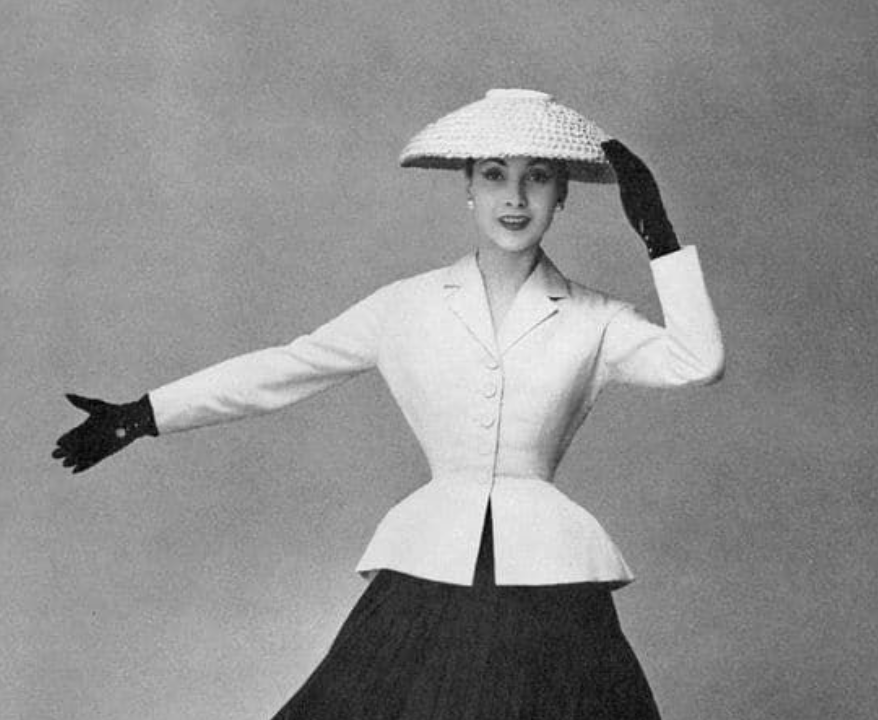
On the morning of 12 February 1947, an unknown forty-one-year-old designer showed his first collection in a converted townhouse at 30 Avenue Montaigne. By the afternoon, the direction of world fashion had changed.
The situation before
France in early 1947 was still rationed. Textile restrictions imposed during the occupation had not been fully lifted, and the previous decade of clothing had been shaped by scarcity: square shoulders, short skirts, minimal fabric, a silhouette borrowed from uniform.
More seriously for Paris, the war had broken the city's monopoly. With Europe closed, American manufacturers had learned to design without French direction, and New York had gained genuine ground. There was an open question as to whether Paris would recover its authority at all.
What Dior actually showed
The collection presented two lines, named Corolle and En Huit, but the elements that mattered were consistent throughout.
The shoulders were rounded and sloped, reversing a decade of padding. The waist was compressed to an extreme degree, often over internal boning. And the skirt was enormous, falling well below the calf and consuming quantities of fabric that were, in the circumstances, genuinely provocative.
Carmel Snow, editor of Harper's Bazaar, is credited with the reaction that named it: that it was such a new look. The phrase entered the language within weeks.
It was not new, technically. It was a return to a nineteenth-century structure. What was new was the audacity of proposing it in that year.
The scandal
The reaction in France was not uniformly admiring, and in places it was physical.
There are documented incidents of women confronting Dior models in the street and attempting to tear the skirts. Public commentary questioned the morality of using twenty metres of cloth for a single garment while the country was rebuilding and many still could not buy sufficient clothing.
Politicians weighed in. In Britain, where rationing was stricter and lasted longer, the government actively discouraged the style.
Why it worked anyway
The criticism was accurate and beside the point.
After six years of scarcity, uniforms and utility cuts, the collection proposed something that had nothing to do with practicality: that abundance was possible again, that the emergency was over, and that a woman might dress in a way that served no function whatsoever.
It was a national mood expressed in fabric. The extravagance was the message, not a side effect of it.
The commercial consequence
American buyers, who had come to Paris uncertain whether it still mattered, bought heavily and immediately. The style was copied at every price level within a single season.
Within two years, Paris had recovered its position as the source of fashion authority. The couture system, which had been legally formalised only two years earlier in 1945, now had a commercial justification to match.
Dior's house grew to account for a very substantial share of all French couture exports within a few years of opening.
The long argument it started
The New Look also reopened a debate that had been running since the 1920s.
Chanel had spent thirty years removing structure from women's clothing: dropping the corset, cutting jersey, borrowing from menswear. Dior restored the structure in a single afternoon, and she is reported to have found the result absurd.
When she reopened her own house in 1954, at seventy-one, it was explicitly in opposition. The Paris press dismissed her comeback as dated. The Americans bought the suits. Within three years the French verdict reversed.
Both arguments turned out to be permanent. Fashion has been oscillating between them ever since.
Standing where it happened
Number 30 Avenue Montaigne is still there, and the salon where the collection was shown is part of the building's history rather than a museum. Nothing marks the spot.
Our fashion history walking tours include Avenue Montaigne alongside the Rue Cambon and Avenue Marceau, explained on site by a Sorbonne-trained historian, in small groups, in English or French.
Dates are available here.
Mademoiselle C
Author