Elsa Schiaparelli: The Rival Who Made Fashion Strange
Lobster dresses, shoe hats and shocking pink: how Schiaparelli fought Chanel for 1930s Paris, lost commercially, and won artistically.
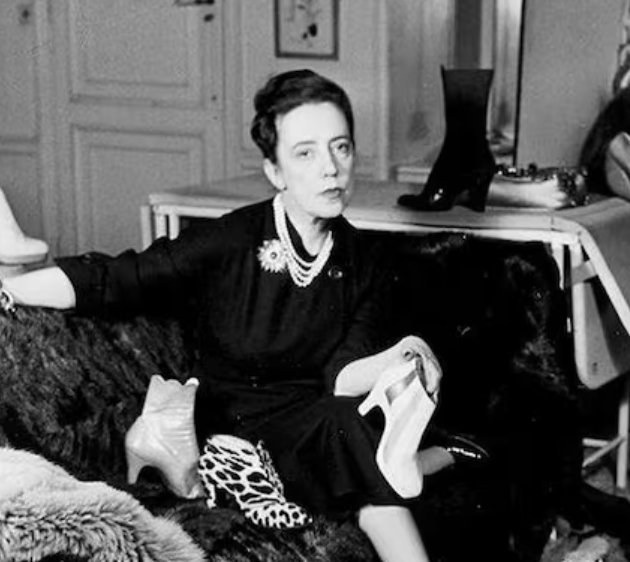
For roughly a decade, Paris fashion had two poles. Gabrielle Chanel offered restraint, jersey and the elimination of the unnecessary. Elsa Schiaparelli offered a hat shaped like a shoe.
Chanel won the twentieth century commercially. Schiaparelli's influence is arguably more visible in what designers do now.
An outsider by construction
Schiaparelli was Italian, born in Rome in 1890 into an academic family, and she arrived in fashion without training, without an apprenticeship and without the workroom background that produced almost every couturier of her generation.
She began with knitwear in the late 1920s, and her first genuine success was a trompe-l'œil sweater knitted to appear as though a bow were tied at the neck. It was an optical joke rendered in wool, and it sold immediately.
Everything that followed was contained in that first idea: clothing as a visual proposition rather than as tailoring.
The surrealist collaborations
Her working relationships with artists were unusually direct, and she treated them as genuine collaborators rather than as decoration.
With Salvador Dalí, she produced the lobster dress (a white silk evening gown with an enormous lobster painted across the skirt) and the shoe hat, worn as a hat, shaped exactly as a shoe, heel upright. With Jean Cocteau, embroidered coats where two profiles resolve into a vase of flowers depending on how you look at them.
She used zips as visible decoration when they were considered strictly utilitarian and hidden. She made buttons in the shape of insects, acrobats and vegetables. She put drawers on a suit jacket.
Chanel called her "that Italian artist who makes clothes". It was not intended as a compliment and it was entirely accurate.
Shocking pink
In 1937 she introduced a magenta so saturated it required a new name, and she named it shocking. The perfume that followed came in a bottle shaped after Mae West's torso.
The colour has outlived essentially everything else she made. It reappears in fashion every few years, usually without attribution.
Why she lost
The Second World War ended her business in practical terms. She left for the United States in 1941 and the house never fully recovered its position afterward.
But the deeper reason is structural. Chanel designed a system; Schiaparelli designed objects. A jersey suit can be reissued for eighty years. A lobster dress cannot be a wardrobe.
The postwar market wanted repeatable clothing, and Dior supplied it in 1947 with a silhouette that could be copied at every price level. Schiaparelli's work resists that kind of reproduction by design.
She closed the house in 1954, the same year Chanel reopened hers.
Why she won anyway
Every designer who treats a collection as an argument rather than a product line is working in her tradition.
The idea that fashion can be witty, that a garment can contain a joke or an image or a piece of criticism, that the runway is a place to say something rather than only to sell : all of that descends from her, not from Chanel.
The house was revived in the twenty-first century and now shows couture again, which is itself a comment on how the balance eventually settled.
Her Paris
She worked from the Place Vendôme, at the centre of the luxury axis, a short walk from the Rue Cambon where Chanel was doing the opposite thing at the same time.
The proximity was not coincidental. The two of them were competing for the same clients, in the same square kilometre, with irreconcilable ideas about what clothing was for.
Our fashion history tours in Paris walk that territory — the Place Vendôme, the Rue de la Paix and the Rue Cambon — with a Sorbonne-trained historian, in small groups, in English or French.
Dates and availability are here.
Mademoiselle C
Author