The Louvre as a Fashion Museum: 7 Masterpieces Every Fashion Lover Must See in Paris
Discover the Louvre through a fashion lens. From Mona Lisa's silk robes to Louis XIV's velvet coronation robes, explore 7 paintings that reveal the history of fashion in Paris's most iconic museum.
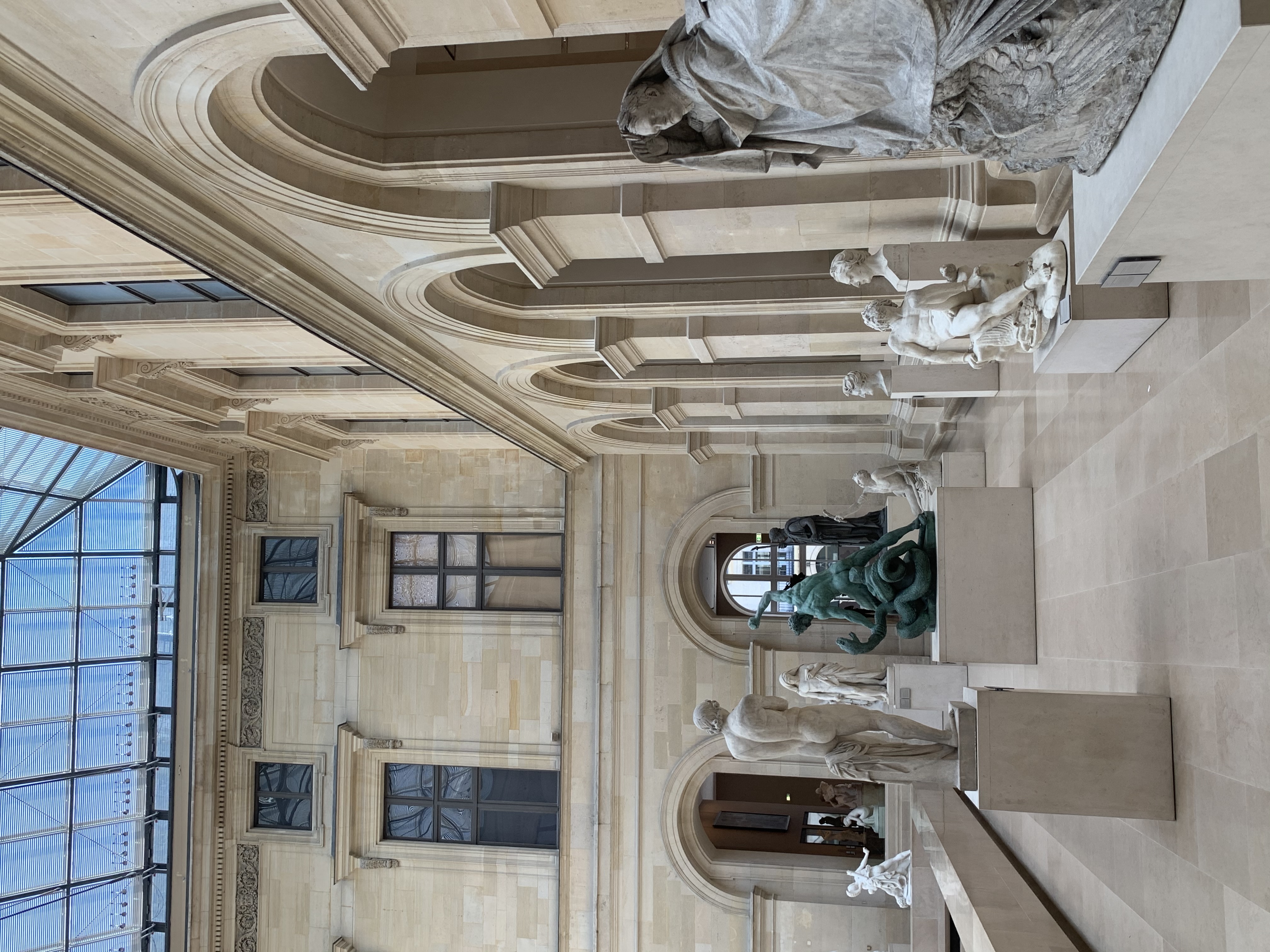
When we think of the Louvre, we think of the Mona Lisa, the Venus de Milo, the Winged Victory of Samothrace. We think of the world's largest art museum — not a fashion museum. And yet, walking through its galleries is like walking through the greatest fashion archive ever assembled. Every portrait is a garment document. Every biblical scene is a runway of its time. Every mythological figure is draped in the fantasies — and realities — of the era that painted it.
In 2025, the Louvre itself acknowledged what art historians have long known: its collection is a repository of fashion history. The landmark exhibition Louvre Couture: Art and Fashion (January 24 – July 21, 2025) placed contemporary haute couture pieces by Chanel, Dior, Dolce & Gabbana, and Yohji Yamamoto in direct dialogue with the museum's permanent collection, demonstrating what the Louvre describes as "common methodological ground in the fields of art history and fashion: knowledge of ancestral techniques, visual culture and the subtle interplay of references, from the catalogue raisonné of the museum to the moodboard of the fashion world" (Louvre official exhibition page).
But you don't need a temporary exhibition to experience fashion at the Louvre. The permanent collection is already a fashion museum in disguise. You just need to know where to look.
As an art history student at Paris 1 Panthéon-Sorbonne, whose research focuses on 15th- and 16th-century Italian female clothing in Florentine painting, I've spent countless hours in the Louvre's galleries reading paintings the way a designer reads a moodboard. What follows is my curated guide to seven masterpieces that every fashion lover should seek out at the Louvre — works that reveal the textures, techniques, and social codes of fashion across five centuries of art history.
1. Mona Lisa (c. 1503–1519) — Leonardo da Vinci ### The Silk Road Worn on a Florentine Woman's Shoulders
Location: Denon Wing, Salle des États (Room 711)
Let's begin with the obvious — because the obvious is more fashionable than most people realize.
The Mona Lisa is not just the most famous painting in the world. It is one of the most important documents of early 16th-century Italian female dress. Lisa Gherardini, wife of the Florentine silk merchant Francesco del Giocondo, is depicted in garments that connect her to the vast networks of Renaissance trade, textile production, and sartorial culture.
Professor Dolores García Ruiz, in her research published by the Mona Lisa Foundation, has demonstrated that the clothes Lisa wears are far from incidental. The dark greenish robe with its spiral patterns and gold thread embroidery, the delicate veil covering her hair, and the semi-sheer shawl draped across her shoulders all point to specific textile traditions. As García Ruiz writes, "the clothes that Lisa Gherardini wears in the portrait definitively link her to the gigantic historical events of her time: the encounter with a New World, the Italian Renaissance, the Silk Roads from the East and the extraordinary economic and cultural flourishing of Valencia in the 15th and 16th centuries" (Mona Lisa Foundation, 2023).
The dyes themselves — likely indigo and madder — tell a story of global commerce. The silk references the Florentine textile industry that made families like the Giocondi wealthy. The veil, a common element of Italian female dress around 1500, reflects both modesty and status. An academic study published on ResearchGate, "Historical Background: Mona Lisa and Italian Female Clothing c.1500" (part of the Bloomsbury Historic Dress in Detail project), further situates Lisa's attire within the broader context of Italian female clothing at the turn of the 16th century (ResearchGate, 2024).
What to look for as a fashion lover: The way Leonardo renders the folds of fabric — not as decoration, but as architecture. The embroidery along the neckline. The veil's transparency. This is not just a portrait; it is a technical study of how fabric falls, how light catches silk, how a garment constructs identity.
2. The Wedding Feast at Cana (1563) — Paolo Veronese ### The Largest Painting in the Louvre Is Also Its Greatest Fashion Show
Location: Denon Wing, Salle des États (Room 711) — directly opposite the Mona Lisa
If the Mona Lisa is an intimate portrait of one woman's dress, Veronese's Wedding Feast at Cana is a panoramic survey of an entire society's wardrobe. Measuring roughly 6.77 × 9.94 meters, it is the largest painting in the Louvre — and it is absolutely teeming with fashion.
Commissioned in 1562 for the refectory of the Benedictine monastery of San Giorgio Maggiore in Venice, the painting depicts the biblical miracle of Jesus turning water into wine. But Veronese, characteristically, transforms a religious narrative into a magnificent 16th-century Venetian banquet. Hundreds of figures are dressed in lavish contemporary costumes — silk brocades, embroidered sleeves, pearl-studded hair, elaborate headdresses, and the rich textiles that made Venice the fashion capital of the Renaissance Mediterranean.
The Louvre's own documentation of its Italian Renaissance collection notes the extraordinary costume detail in Veronese's work, where "lavish costumes, musicians, and incredible architectural details" transform a biblical scene into a document of Venetian material culture (Louvre visitor trails).
The painting also reveals the social coding of Venetian dress. As the Louvre's exhibition on Venetian Renaissance painters explained, "Dress and attributes would reveal a man's rank and office. Attire was even more important for women than men, given their lack of public activity. The Venetian authorities even had to bring in laws to regulate extravagant expenditure — costumes and finery were not to exceed a certain price fixed by the Republic" (Louvre: Titian, Tintoretto, Veronese exhibition). Sumptuary laws — regulations limiting luxury in dress — are visible right here in the painting, encoded in the very garments Veronese depicts.
What to look for as a fashion lover: The musicians in the foreground (including a self-portrait of Veronese as a viola player). The women's elaborate jewelry. The contrast between the classical drapery of the biblical figures and the contemporary Venetian fashion of the wedding guests. This painting is a 16th-century fashion editorial in oil.
3. Man with a Glove (c. 1520) — Titian ### The Birth of Fashionable Masculinity
Location: Denon Wing, Grande Galerie (Room 710)
If you're interested in the history of menswear — and any serious fashion lover should be — Titian's Man with a Glove is essential viewing. This portrait, dated to around 1520, is widely considered one of the finest male portraits of the Italian Renaissance, and it captures a moment when male fashion was undergoing a profound transformation.
The unidentified young man is dressed in the height of Venetian fashion: a dark, sober doublet with a white chemise visible at the collar, a leather glove held casually in one hand, and an overall aesthetic of restrained elegance that feels startlingly modern. The Fashion History Timeline at the Fashion Institute of Technology (FIT), which catalogues this painting as held at the Louvre (INV 771), positions it within the broader evolution of 1520s menswear (FIT Fashion History Timeline, 1520-1529).
What makes this painting revolutionary for fashion history is its rejection of ostentation. Unlike earlier Renaissance portraits that signal wealth through gold, jewels, and elaborate decoration, Titian's subject conveys status through simplicity — through the cut of his garment, the quality of his leather glove, the nonchalance of his pose. This is the aesthetic of sprezzatura, the artful effortlessness that Baldassare Castiglione codified in The Book of the Courtier (1528). It is, in many ways, the philosophical ancestor of modern minimalism.
The costume book De gli habiti antichi et moderni di diverse parti del mondo (1590) by Cesare Vecellio — a cousin of Titian's — provides essential context for understanding Venetian fashion in this period. As the Städel Museum noted in its exhibition on Titian and Renaissance Venice, Vecellio's work documents "contemporary fashions in Venice and beyond" and helps us read the sartorial choices in Titian's portraits with precision (Städel Museum).
What to look for as a fashion lover: The glove. In Renaissance portraiture, gloves were luxury accessories — expensive, scented, and symbolic. The way the man holds it, almost carelessly, is a statement. Also note the black of the doublet: black dye was among the most expensive in the Renaissance, achieved through complex processes involving logwood and iron mordants. Wearing black was a flex.
4. The Fortune Teller (c. 1595) — Caravaggio ### Street Style in Baroque Rome
Location: Denon Wing, Grande Galerie (Room 712)
Not all fashion history happens in courts. Caravaggio's The Fortune Teller takes us to the streets — or rather, to the kind of encounter that could happen on any street in late 16th-century Rome, where a young, fashionably dressed nobleman is being seduced and robbed by a Romani fortune teller.
What makes this painting extraordinary for fashion history is its depiction of everyday clothing — not ceremonial dress, not court costume, but the garments people actually wore in daily life. The young man's outfit — with his plumed hat, his lace collar, his dark doublet, and his sword — represents the standard fashionable attire of a Roman gentleman around 1595. The fortune teller's simpler dress, with its white chemise and loose bodice, contrasts sharply, encoding class difference through fabric and cut.
Caravaggio's realism was revolutionary. Where earlier painters idealized their subjects, Caravaggio painted what he saw — real people in real clothes. This makes his work an invaluable source for costume historians who study not just what the elite wore on ceremonial occasions, but what people wore in the streets, in taverns, in everyday encounters.
The painting is documented in the Louvre's Italian painting collection, which spans the 13th to 18th centuries and includes major works by Caravaggio alongside Leonardo, Raphael, and Titian (Louvre Italian Painting collection).
What to look for as a fashion lover: The lace. The plume in the hat. The way the young man's hand reaches toward the fortune teller's — a gesture that is both romantic and, unknowingly, the moment he's being robbed. Fashion as performance, fashion as vulnerability.
5. Portrait of Louis XIV (1701) — Hyacinthe Rigaud ### The Original Fashion Dictator
Location: Sully Wing, Room 916
No discussion of fashion in art would be complete without Louis XIV — the king who made France the fashion capital of Europe and used clothing as a tool of political absolutism.
Hyacinthe Rigaud's monumental portrait (277 × 194 cm), painted in 1701 and held at the Louvre, is the definitive image of the Sun King. Louis XIV is depicted in his coronation robes: a massive ermine-lined velvet mantle, the royal sword, the crown, and — crucially — the shoes with red heels that became one of the most famous fashion statements in history.
The red-heeled shoes were not merely decorative. They were a marker of royal privilege. Only those permitted by the king could wear them, and they became a symbol of aristocratic status at Versailles. In this sense, the portrait is not just a depiction of a man in fancy clothes — it is a political document that encodes the relationship between fashion and power in absolutist France.
The Fashion History Timeline at FIT catalogues this painting within the context of 1700s fashion, noting the Louvre's version (inv. 7550) alongside the Prado's copy (FIT Fashion History Timeline, 1701). The portrait exemplifies what the Wonderful Museums project describes as the use of fashion to "convey distinct messages of power and cultural identity" in the context of European court dress (Wonderful Museums).
The 2025 Louvre Couture exhibition made this connection explicit: a spectacular silk Dior gown featuring a Sun King motif was staged before a baroque portrait of Louis XIV, creating a direct line from 17th-century royal fashion to 21st-century haute couture (CNN, January 2025).
What to look for as a fashion lover: The red heels. The ermine. The way the mantle's blue fabric (associated with the Order of the Holy Spirit) creates a color palette that would influence French royal fashion for generations. This is the painting where French fashion as a global force is born.
6. Portrait of Madame de Verninac (1799) — Jacques-Louis David ### Neoclassical Fashion and the Revolution in Dress
Location: Sully Wing, Room 758
Fashion doesn't just reflect aesthetics — it reflects politics. And few paintings demonstrate this more powerfully than Jacques-Louis David's portrait of Madame de Verninac, painted in 1799 and held at the Louvre (RF 1942-16).
After the French Revolution, the extravagant silks, powdered wigs, and panniers of the Ancien Régime were replaced by a radically different aesthetic: neoclassical dress. Inspired by the archaeological discoveries at Pompeii and Herculaneum, and driven by a political rejection of aristocratic excess, women's fashion in the Directory and Consulate periods adopted high waists, lightweight muslin fabrics, and simple, columnar silhouettes that evoked classical antiquity.
Madame de Verninac — née Henriette de Verninac, sister of David's student and friend — is depicted in precisely this style. Her white muslin dress, high waistline, and simple shawl represent the new ideal of post-revolutionary femininity: natural, uncorseted, and politically charged. The FIT Fashion History Timeline places this portrait within the 1790s fashion context, documenting the shift from Ancien Régime opulence to neoclassical simplicity (FIT Fashion History Timeline, 1790-1799).
This painting is also a reminder that Paris has always been the city where fashion and politics intersect. The garments worn by Madame de Verninac were not just a style choice — they were a statement about what kind of society post-revolutionary France aspired to be.
What to look for as a fashion lover: The high waistline (empire silhouette, avant la lettre). The muslin fabric — light, unstructured, a deliberate rejection of the heavy silks of the pre-revolutionary era. The shawl, which would become one of the most iconic accessories of the early 19th century.
7. Portrait of Charles VII (c. 1445–1450) — Jean Fouquet ### The Foundation of French Fashion Portraiture
Location: Sully Wing, Room 804
We end where French fashion portraiture begins. Jean Fouquet's portrait of King Charles VII, dated to approximately 1445–1450 and held at the Louvre (INV 9106), is one of the earliest independent royal portraits in French art — and a foundational document for the history of French fashion.
The painting depicts Charles VII in a relatively simple dark robe with a fur collar, his hands resting on a prayer desk. The austerity of the garment is striking — this is not the opulent display of later royal portraits, but a deliberate image of piety and humility. And yet, the fur collar, the cut of the robe, and the red fabric behind the king all encode status in ways that would have been immediately legible to a 15th-century viewer.
The FIT Fashion History Timeline documents this portrait within the 1440s fashion context, noting its significance as an early example of French portraiture that records contemporary dress (FIT Fashion History Timeline, 1440-1449). For anyone interested in the origins of French fashion — the long history that would eventually make Paris the fashion capital of the world — this is where the visual record begins.
What to look for as a fashion lover: The fur collar. The simplicity of the robe. The way Fouquet uses fabric and color to communicate rank without ostentation — a principle that would, centuries later, find its echo in the minimalist elegance of French fashion houses from Chanel to Celine.
The Louvre Is a Fashion Museum. Always Has Been.
Walking through the Louvre with fashion in mind transforms the experience entirely. Paintings you might have passed without a second glance become windows into the history of textiles, the politics of dress, the economics of luxury, and the social codes encoded in every sleeve, every hem, every choice of color.
The 2025 Louvre Couture exhibition was not a departure for the museum — it was a homecoming. As the Louvre itself stated, the exhibition embraced "common methodological ground in the fields of art history and fashion" (Louvre official). The museum has always been a fashion museum. It just took a temporary exhibition to make us see it.
But you don't need an exhibition. You need a map, a bit of knowledge, and the willingness to look at paintings the way a designer looks at a moodboard — with an eye for texture, silhouette, color, and the stories that garments tell.
That's what I do every day as an art historian researching 15th- and 16th-century Italian female clothing. And that's what I'd love to share with you on my fashion tours in Paris — where we'll explore not just the Louvre, but the entire city as a living museum of fashion history.
Practical Information for Your Fashion Lover's Louvre Visit
- Museum: Musée du Louvre, Paris
- Address: Rue de Rivoli, 75001 Paris
- Website: louvre.fr
- Recommended route: Begin in the Denon Wing (Italian paintings: Mona Lisa, Wedding at Cana, Man with a Glove, Fortune Teller), then proceed to the Sully Wing (French paintings: Louis XIV, Madame de Verninac, Charles VII)
- Time needed: Allow at least 3 hours for this fashion-focused itinerary
- Pro tip: Visit on Wednesday or Friday evenings when the museum is open late and less crowded
Sources & Further Reading
- García Ruiz, Dolores — "Dyes and Silk in the Mona Lisa" — The Mona Lisa Foundation, 2023 — Link
- ResearchGate — "Historical Background: Mona Lisa and Italian Female Clothing c.1500" — Bloomsbury Historic Dress in Detail, 2024 — Link
- Musée du Louvre — "Louvre Couture: Art and Fashion" Exhibition Page, 2025 — Link
- Musée du Louvre — "Titian, Tintoretto, Veronese: Rivals in Renaissance Venice" — Patricians and Patrons — Link
- Musée du Louvre — "Treasures of the Italian Renaissance" Visitor Trail — Link
- Fashion History Timeline, FIT — 1520-1529 (Titian, Man with a Glove) — Link
- Fashion History Timeline, FIT — 1701: Hyacinthe Rigaud, Louis XIV — Link
- Fashion History Timeline, FIT — 1790-1799 (David, Madame de Verninac) — Link
- Fashion History Timeline, FIT — 1440-1449 (Fouquet, Charles VII) — Link
- The Metropolitan Museum of Art — "Renaissance Fashion and Dress Codes" — Link
- Städel Museum — "Titian and the Renaissance in Venice" (Cesare Vecellio costume book reference) — Link
- CNN — "Louvre Museum in Paris opens first ever fashion exhibition" — January 2025 — Link
- ResearchGate — "Renaissance Splendor: Fashion from 1450-1624" — Link
- Wonderful Museums — "Paris Louvre Fashion Exhibit: Unveiling Elegance, History, and Influence" — Link
Mademoiselle C
Author