Le Smoking: How Saint Laurent Put Women in a Tuxedo
In 1966 Yves Saint Laurent cut a tuxedo for women. Restaurants refused them entry — which was precisely the proof that it worked.
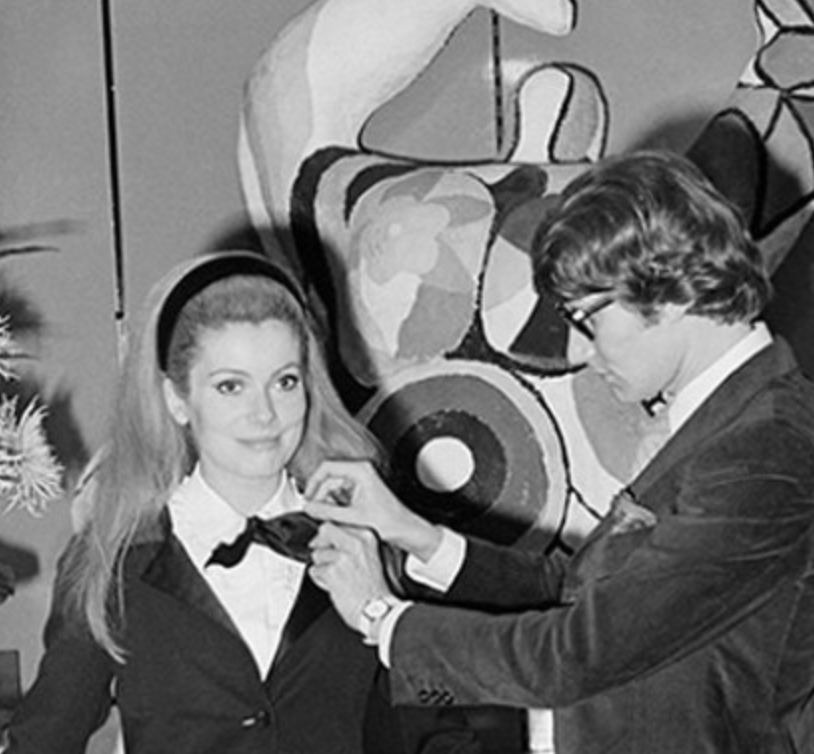
In 1966, Yves Saint Laurent showed a tuxedo cut for a woman's body and intended to be worn in the evening, in places where a gown was expected. He called it le smoking. It is arguably the single most consequential garment of the second half of the twentieth century.
What made it different from trousers
Women had worn trousers before, extensively. Chanel put them on the beach in the 1920s. Marlene Dietrich wore men's tailoring in the 1930s. Trousers were normal for work, sport and leisure well before 1966.
What had not happened was formal eveningwear. The evening was the last territory where a woman was still required to appear in a dress, and the requirement was enforced socially rather than legally.
Saint Laurent did not adapt a tuxedo into something dress-like. He cut the thing itself : the satin lapel, the trouser, the sharp shoulder, for a woman, and put it exactly where a gown was mandatory.
Trousers were already permitted. What he attacked was the last room where they were not.
The refusals
The reaction proved the point faster than any review could.
The most repeated account concerns Nan Kempner, a prominent New York socialite, turned away from a restaurant for wearing the smoking. The reported response (removing the trousers and wearing the jacket alone as an extremely short dress) may have improved in the retelling, but the refusal itself was entirely typical.
Similar exclusions occurred across New York, London and Paris. Establishments enforced dress codes that had never needed writing down because nobody had previously tested them.
Every refusal generated press. Every article explained the garment to people who had not seen it.
Why it was a fashion argument, not a political one
Saint Laurent was not primarily making a statement about equality, and he tended to resist that framing.
His interest was in transferring the authority of menswear : its precision, its sharpness, its refusal to be decorative ; onto a woman without softening it. The garment is not a costume and it is not androgynous in the sense of being neutral. It is deliberately, aggressively tailored.
The political reading arrived anyway, because the garment kept being refused entry, which turned a cut into a position.
The wider pattern in his work
The smoking was one instance of a method he used repeatedly: taking a garment with a fixed masculine or functional identity and giving it to women without apology.
The safari jacket. The trench. The jumpsuit. The transparent blouse, which caused its own scandal for entirely different reasons.
He also did something structurally more important than any single design. In 1966 he opened Saint Laurent Rive Gauche, treating ready-to-wear as a serious creative proposition rather than a commercial compromise. Real design, in standard sizes, at prices ordinary women could reach.
That decision did more to change what people actually wear than the couture did.
Where to see it
The Musée Yves Saint Laurent at 5 Avenue Marceau occupies the couture house where he worked from 1974 to 2002. The studio is preserved close to how he left it, the boards, the swatches, the working disorder.
It is a small museum and not a glamorous one, which is exactly why it is the most instructive fashion room in Paris. Book ahead in high season.
Walking the argument
Avenue Marceau sits a short walk from Avenue Montaigne, where Dior restored structure in 1947, and from the Rue Cambon, where Chanel spent thirty years removing it. Three addresses, three incompatible answers to the same question.
Our fashion history tours in Paris walk that route with a Sorbonne-trained historian, in small groups, in English or French.
Dates and booking are here.
Mademoiselle C
Author